Test Systems
GtestWorks Automated Testing Platform
VectWorks 3.0 Electrical Performance Test Software


Electromagnetic Compatibility (EMC) refers to the ability of electrical equipment or systems to operate without causing electromagnetic interference to their environment or being susceptible to such interference. As a critical quality benchmark, EMC compliance should be addressed during the initial product design phase through cost-effective countermeasures. By definition, EMC comprises Electromagnetic Interference (EMI) and Electromagnetic Susceptibility (EMS).
Electromagnetic Compatibility (EMC) refers to the ability of electrical equipment or systems to operate without causing electromagnetic interference to their environment or being susceptible to such interference. As a cr···
The biggest risk in EMC testing is not finding a problem. It is finding the problem only when the product is already in formal certification. Many teams end up in repeated rework not because the product is impossible to pass, but because the test environment, sample configuration, standards interpretation, and corrective-action loop were never made solid early enough. This page turns the most common EMC mistakes into a practical framework your R&D, test, and certification teams can use together.
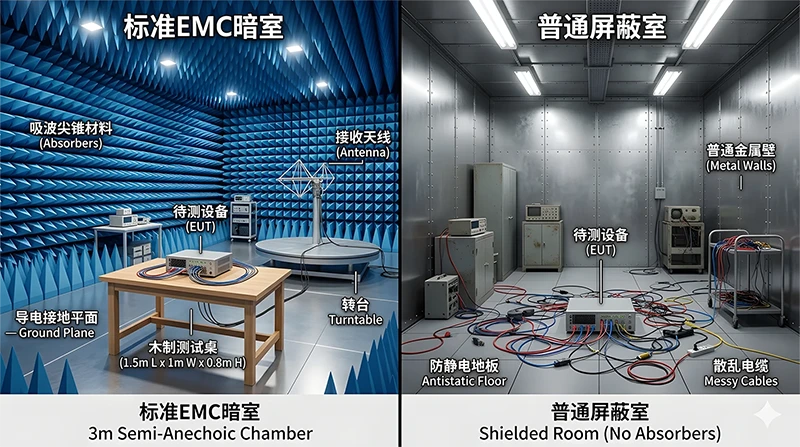
Electromagnetic Compatibility (EMC) refers to the ability of electronic equipment or systems to function properly in their electromagnetic environment without causing unacceptable electromagnetic disturbances to anything in that environment. Its core encompasses two interrelated technical dimensions: Electromagnetic Interference (EMI) and Electromagnetic Susceptibility (EMS). EMI refers to the electromagnetic disturbances released by equipment during operation into the surrounding environment, while EMS refers to the equipment's ability to resist external electromagnetic disturbances.